
In a busy hiring cycle, first-round calls can become repetitive. One recruiter asks about project experience, another focuses on notice period, and a third spends most of the conversation walking through the resume. Hiring managers then receive notes that are difficult to compare.
A structured first round starts with a simple decision: what must the team learn before deciding who moves forward? The answer might be relevant experience, motivation for the role, communication around a work example or a few role-specific questions.
Prepare a small set of core questions tied to the job and agree on what a useful answer should cover. For a customer-facing implementation role, that might mean explaining a difficult client issue. For an engineering role, it could mean describing a technical decision and the trade-offs involved.
Keep room for follow-up where the format allows it. Candidates should know what to expect, how long the stage takes and how their responses will be used. A process is not fair simply because everyone receives the same link; it also needs clear instructions and a relevant evaluation.
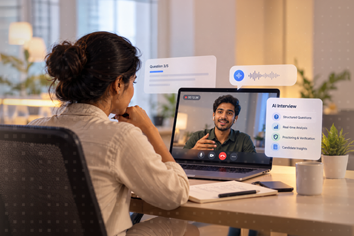
Video interviews can help when the team is screening applicants across locations or coordinating several open roles. They can give recruiters a consistent set of responses to review before scheduling longer conversations. That can be useful for companies hiring across Bengaluru, Hyderabad, Pune, Chennai and other talent hubs.
They are not the right answer for every role or every candidate. Some questions need a live exchange, and accessibility or connectivity needs should be considered. Deloitte India's FY25 campus hiring report provides broader context on how recruitment teams are adapting their early-career processes; it does not, by itself, prove that one interview format is best.
Use the criteria agreed before the interview. Note the evidence in the response, what remains unclear and which question should be explored in the next stage. Avoid confusing a confident delivery or a particular accent with the ability to do the job.
If the next step is a technical assessment, let it assess something different. The candidate should not have to repeat the same story in every round.
It supports video-based interviews and may help teams structure, organise or review candidate responses.
Not necessarily. It can support an early stage, while live conversations remain useful for deeper discussion.
Use the same core role-related questions and a clear set of evaluation criteria.
Aikam's AI Video Interviews help teams introduce a structured first-round stage when coordinating every initial conversation becomes difficult. Set role-related questions, review candidate responses and decide who should move to a deeper conversation.
Explore Aikam AI Video Interviews